Management of blackleg in canola is important to ensure healthy crops
Published 3:12 pm Friday, April 24, 2026
Blackleg Disease has been around on the prairies for 40 or 50 years now, and it’s important for producers to know about the best management practices, like resistance field ratings.
Blackleg is born on plant stubble, on plant residue, like the stems and roots.
“It can persist for basically as long as the stubble is around, but typically, it’s two-year-old stubble is where we have most of the spores produced…” said Curtis Rempel, vice president of innovation, production and supply for the Canola Council of Canada.
The spores are released from the stubble, carried by wind and rain, affecting a new crop.
“Early infections are the ones that are the most damaging, so we have conditions early in spring that are wet. We have a lot of fog and mist, and temperatures are warming up, and that’s conducive for Blackleg.”
What really saved the crop, Rempel said, was the discovery of resistance genes to blackleg, with a number of things early on, but the biggest gene that really stopped it in its tracks came out of the University of Alberta.
A group of pathologists working across Canada identified the gene, and Gary Stringam put it into canola varieties suitable for farmers, with the industry picking it up and using it to put it into their varieties.
“Like everything else, eventually the disease, whether it’s herbicide resistant weeds or diseases, insects, eventually the pathogen starts overcoming the disease, that one resistance gene, so the fungus builds up again, and farmers start seeing yield loss,” said Rempel, adding that you then have to look for new genes.
Growers associations, industry, universities and Ag Canada, especially private industry, have been active in identifying new resistance genes and putting those resistance genes in high-yielding canola hybrids.
“There are a bunch of them that are already in varieties that farmers can grow. We have the tools in place to manage the disease. We have new resistance genes coming into all of our varieties, and then we also have something called quantitative resistance, or minor gene resistance or horizontal resistance,” he said.
There’s a number of different scientific or technical terms, but it’s where you have a number of small minor genes or smaller genes that taken together have an additive effect.
“Our seed companies are using that minor gene resistance. They’re also using that to great effect now. It’s starting to become important in disease management as well. It’s another tool that growers have.”
Canola Council of Canada is also working on other ways to manage blackleg, with some research still in play, and some that are wrapping up that identify new sources of resistance that their seed companies can use in their breeding programs.
“They’re always on the front line for identifying and working with the latest and greatest genes,” he said, adding that it can take five to seven years to get a new gene incorporated into a hybrid and into the marketplace for farmers.
When it comes to the management of blackleg, the Canadian Council of Canada also recommends fungicide products, which are available, but in order for them to be effective, farmers must apply them really early in the growing season, before the two-leaf stage.
“If you’re not getting it on from cotyledon to leaf, your wasting your money,” said Rempel.
Once a plant reaches past the six-leaf stage, and it starts bolting and flowering, any infections after that don’t have any impact on yields.
When inspecting crops, farmers and producers should look for a yellow lesion or brown dying spot, which is typically surrounded by what looks like black dots of pepper, and those are the fungal bodies that would release spores.
“What happens then is the fungus lands on the leaf surface, and if there’s enough moisture on the leaf surface and in the air, and you have you have favourable temperatures, those spores germinate, and then they will grow down the leaf.”
Rempel said they still encourage growers and even agronomists to make sure things are working for them, even if they have a resistant variety.
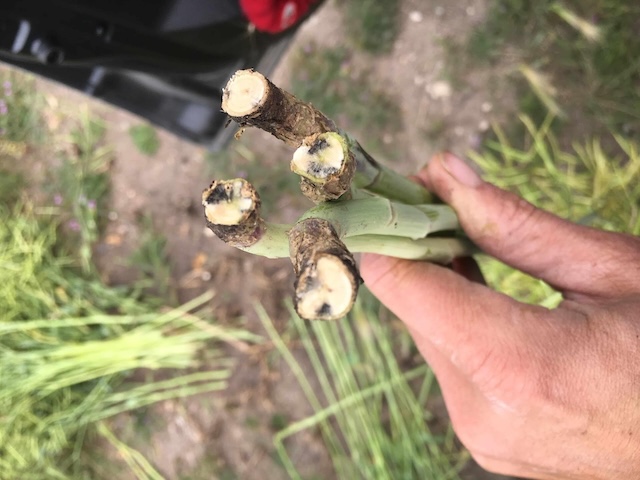
“We encourage growers and agronomists to pull some of the stubble. You cut right at the base of the plant, right where the root and the stem come together at the soil surface, and you cut a cross section, and you can see some very distinctive discolouration inside the stem at that point in time.”
They can then do an assessment of whether or not their management practices are working for them, one being the right resistance genes for their field, or along with getting on a fungicide application early enough.
The other effective piece is seed treatments, which a lot of growers are using for stopping the disease, but that can vary in effect year to year based on environmental conditions in the soil.
More funding and research are being looked into, identifying new sources of resistance and ways to use them.
“We’re always looking for new genetic material, new approaches, new products.
“There is something called RNA interference, which is similar technology that made our Covid vaccine possible. That technology now looks like we’re going to be able to use it potentially effectively for developing a product against the blackleg fungus, so there’s lots of new stuff coming.”
Information is highlighted on their research hub through canaolacouncil.org.
About Carlie Sanderson

With over 10 years as a journalist, Carlie prides herself as a storyteller in various beats. She started her career with Black Press on Vancouver Island in 2015 before heading out to Central Alberta two years later where she worked as a reporter and editor, along with founding a country focussed magazine, where she wrote and took photos.
Having grown up riding horses all her life, Carlie’s passion lies in the equestrian world. Although she hasn’t ridden in a long time, she now loves to be a spectator at various rodeos across Central Alberta with her family.
She currently resides in Sylvan Lake with her husband and three young boys.
 More by Carlie