Drone spraying gets the green light, a huge plus for farmers
Published 3:15 pm Friday, June 19, 2026
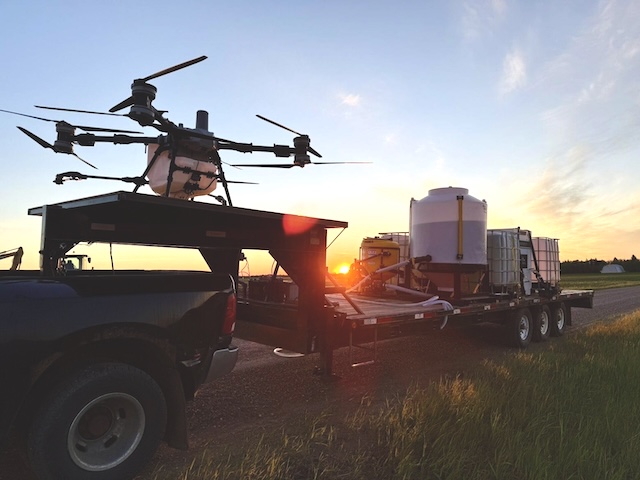
Farmers will now reap the benefits of pest control with spray drones.
Last week, Health Canada’s Pesticides Regulatory Directorate (PRD) issued a Letter of No Objection, which will now allow drones to be used for the application of pest control products with aerial labels.
The PRD, an agency of Health Canada, has been responsible for authorizing different pest control products for use in Canada. Up until recently, there was a regulatory barrier that prevented drones from being used for pest control product application.
“They had been saying that drones aren’t an aircraft, and because of that, there’s no way to use them until an individual label has been approved for your own use. That basically changed in February when the agency proposed that they basically grandfather area labels,” said Markus Weber, president of the Canadian Agricultural Drone Association and Owner of Landview Drones.
He added that anything that already has been approved for application by manned aircraft could also be applied by unmanned aircraft.
“That proposal is still outstanding, so they’re considering it. They had a consultation period and they will be issuing that policy in the near future, but given the urgent circumstances around the wet fields this spring they’ve issued that letter of no objection to let people apply now while we’re waiting for that final policy decision,” said Weber.
In terms of interest in drones, Weber believes it’s been growing over the last few years, but it just peaked with the recent announcement.
Weber’s Landview Drones sells drones for scouting, mapping and application, with application drones being their highest interest ones right now given the wet spring in Alberta so far.
“Those application (spray drones) depending on the model and specific use case, they’ll cover anywhere from 15 to 90 acres in an hour, but typical is in the 40 to 60 acre per hour range,” said Weber.
In the longer term, they see the biggest benefit being when the crops are large, as the drones don’t trample the crop.
“So that’s applying things like fungicide and desiccant where you would otherwise be trampling the crop. The drone has incredible drop downdraft to reach the pest control products down deeper into the canopy and has the added benefit of not trampling two to three percent of the crop, which is typical for a ground sprayer.”
Weber said this spring, because it’s so wet in most areas, there’s interest in using herbicides as well, as people just can’t get into the field with a ground sprayer and the drone can still get the job done.
Given the increased interest, Landview Drones has lots of training planned this summer.
On June 30 they will have a drone spreading and seeding workshop, and on July 2 and 3 they will have a drone spraying boot camp they will be holding in Camrose.
About Carlie Sanderson

With over 10 years as a journalist, Carlie prides herself as a storyteller in various beats. She started her career with Black Press on Vancouver Island in 2015 before heading out to Central Alberta two years later where she worked as a reporter and editor, along with founding a country focussed magazine, where she wrote and took photos.
Having grown up riding horses all her life, Carlie’s passion lies in the equestrian world. Although she hasn’t ridden in a long time, she now loves to be a spectator at various rodeos across Central Alberta with her family.
She currently resides in Sylvan Lake with her husband and three young boys.
 More by Carlie