Increase in general twine collection across the province
Published 11:07 pm Wednesday, July 22, 2026
|
Getting your Trinity Audio player ready...
|
The final winners were announced for this year’s Great Twine Round-Up Contest, a contest that rewards Albertans for collecting used agricultural plastic baler twine for recycling.
The Great Twine Round-Up is part of the larger Alberta Ag-Plastic Recycle It! Program, which is a multi-year pilot program funded by the Government of Alberta, with funds administered by the Alberta Beef Producers and Cleanfarms operating the program.
The first iteration of the Great Twine Round-Up was in the winter of 2024 through to 2025, which saw great success with over around 16,000 kilograms of used baler twine and over 660 entries.
“What we saw is that it actually led to more twine coming into municipal collection sites across the province throughout that year,” said Davin Johnson, Alberta program advisor with Cleanfarms based out of Lethbridge.
It was then decided to run the contest again, but with a shorter contest window, because the pilot program was scheduled to terminate in December of 2025, but the Government of Alberta requested they extend the term until the end of 2027.
“With the shorter window, we did have a few less entries,” said Johnson, adding that they received 76 entries from 17 different participants this year, which accounted to approximately 1,900 kilograms of used baler twine, based on one entry being a full bag of used baler twine.
He said the real success of the contest is helping build the habit of recycling in the province.
Although there were less entries this year, Johnson said the reach was very successful through the advertising of the contest across several platforms, which generated 4.6 million impressions, over 260,000 link clicks and 2.8 million mid video views.
Like the first contest, there were four $3,000 prizes to support 4-H clubs and an individual farm where they would donate their winnings to an Alberta-based agricultural not-for-profit or charity of their choice.
The winner in the individual category this year was the MTM Agricultural Society, the early bird prize category winner went to the Lethbridge Northern 4-H Beef Club, while the 4-H Club Category winners went to the Rocky South 4-H Beef Club and Hanna Rangeland 4-H Multi Club.
They will be running the contest again beginning November of 2026 through to May of 2027.
“As a result in this last year, we’ve seen an increase in general twine collection across the province, and I would suggest that that’s a result of the previous contest.”
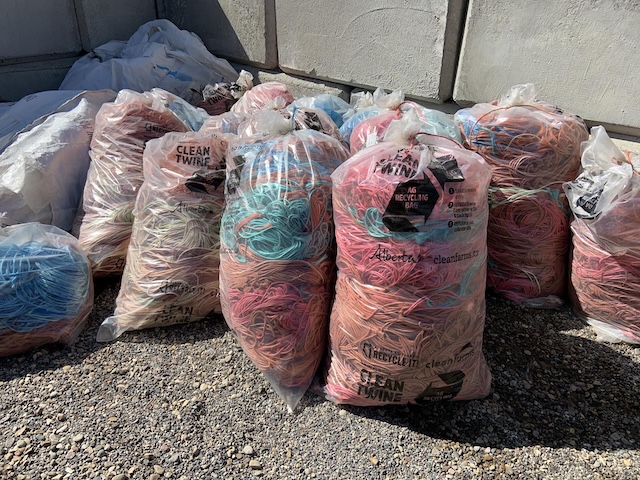
Farmers or 4-H clubs can collect their used plastic baler twine in free Cleanfarms program collections bags that they can get from any collection site in the province.
“There’s over 170 collection sites for twine, so there’s a lot of access throughout corner to corner of the province. They label the bag with their 4-H club or farm name, the date, and then drop it off at the participating site, take a photo and submit the entry online” he said.
Johnson said a big reason they involve 4-H clubs is because it’s a natural fit as it connects youth, farm families and local communities. It’s also rewarding the people already doing the work and giving some prize money back into the community, along with getting the next generation of farmers in the mindset and habits of recycling.
All of the twine collected gets recycled in various places depending on markets where the plastic is sent for recycling to mechanical recyclers where they turn it into little plastic pellets, which are used to manufacture new items like car parts, dimensional lumber, decking furniture and more.
“We try and keep it in Canada as much as possible.”
The pilot project was extended until the end of 2027, with the Government allowing them to include a smaller scale pilot for silage, plastic and bale wrap, with the formal collection of those being launched in October in about four to six different municipalities across the province.
“It gives us a chance to test collection options and processes which enables more plastics on farms to be managed in a responsible manner for farmers in the future.”
About Carlie Sanderson

With over 10 years as a journalist, Carlie prides herself as a storyteller in various beats. She started her career with Black Press on Vancouver Island in 2015 before heading out to Central Alberta two years later where she worked as a reporter and editor, along with founding a country focussed magazine, where she wrote and took photos.
Having grown up riding horses all her life, Carlie’s passion lies in the equestrian world. Although she hasn’t ridden in a long time, she now loves to be a spectator at various rodeos across Central Alberta with her family.
She currently resides in Sylvan Lake with her husband and three young boys.
 More by Carlie